Mathematics
We nurture critical thinking and computational skills in Eliasians through the learning of Mathematics.
Vision
Critical and creative thinkers who are independent and innovative problem-solvers in an ever-changing world.
Mission
We seek to prepare our students for life by providing them with the essential mathematical knowledge and developing their thinking skills.
Learning Outcomes
Students who can adapt and apply their problem-solving skills in daily life.
Students who possess both critical and creative thinking.
Approach/Framework
Curriculum
Elias Park Primary School adopts the 2021 Mathematics syllabus (P1-P6) which reflects the recent development and trends in mathematics education. We emphasize conceptual understanding, skill proficiency and mathematical processes, reasoning and communications which are integral to the development of mathematical problem-solving ability to think logically, abstractly, critically and creatively. Below is the MOE’s Mathematics Framework.
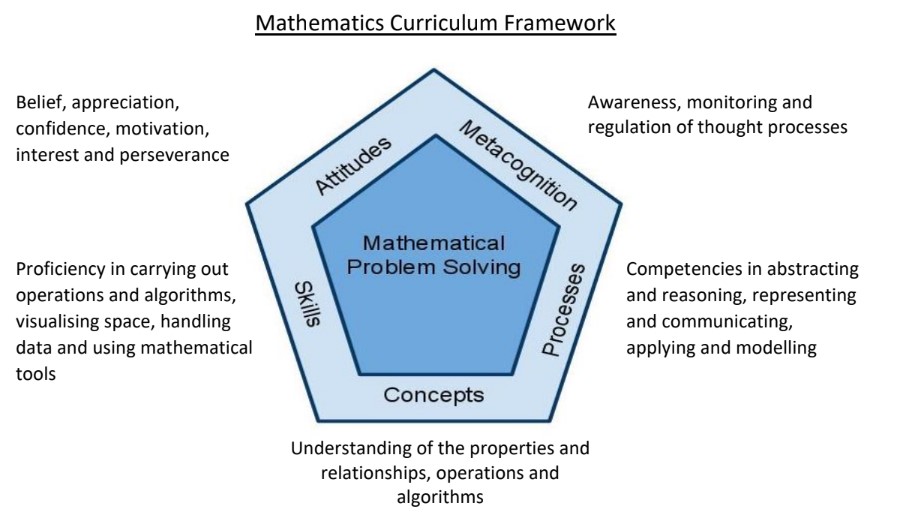
The central focus of MOE’s Mathematics Framework is mathematical problem solving. This sets the direction for and provides guidance for the Mathematics Department in the teaching and learning and the assessment of mathematics.
• Goals/Objectives
- To achieve performance in PSLE by maintaining above National
Average result and improving the quality and quantity passes.
- To nurture Eliasians to be creative thinkers, self-directed,
independent learners and innovative problem solvers by
enriching them with mathematics content, knowledge and skills.
• Focus
- Visible Learning
- Experiential Learning through activity-based lessons
- Formative Assessments
Every Eliasian should experience these 3 phases of learning:
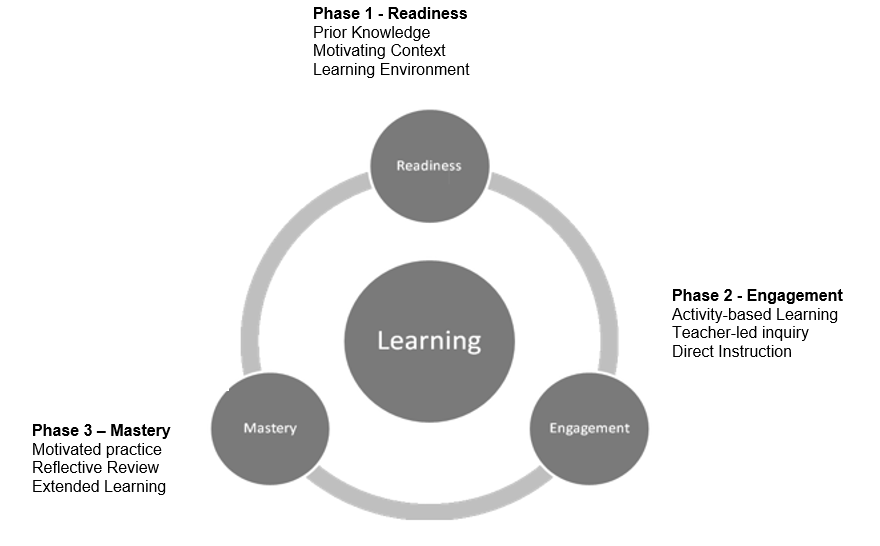
Interweaved into the 3 phases of learning is the Concrete-Pictorial-Abstract approach, the key pedagogy that teachers are using.
The concrete-pictorial-abstract approach consists of 3 stages necessary for students to develop understanding of a concept. Reinforcement is achieved by going back and forth between these representations.
Concrete representation - a student is first introduced to an idea or a skill by acting it out with real objects or manipulatives to develop the foundation for conceptual understanding.
Pictorial representation - a student has sufficiently understood the hands-on experiences performed and can now relate them to representations, such as a diagram or picture of the problem.
Abstract representation - a student is now capable of representing problems by using mathematical notation.
Programmes
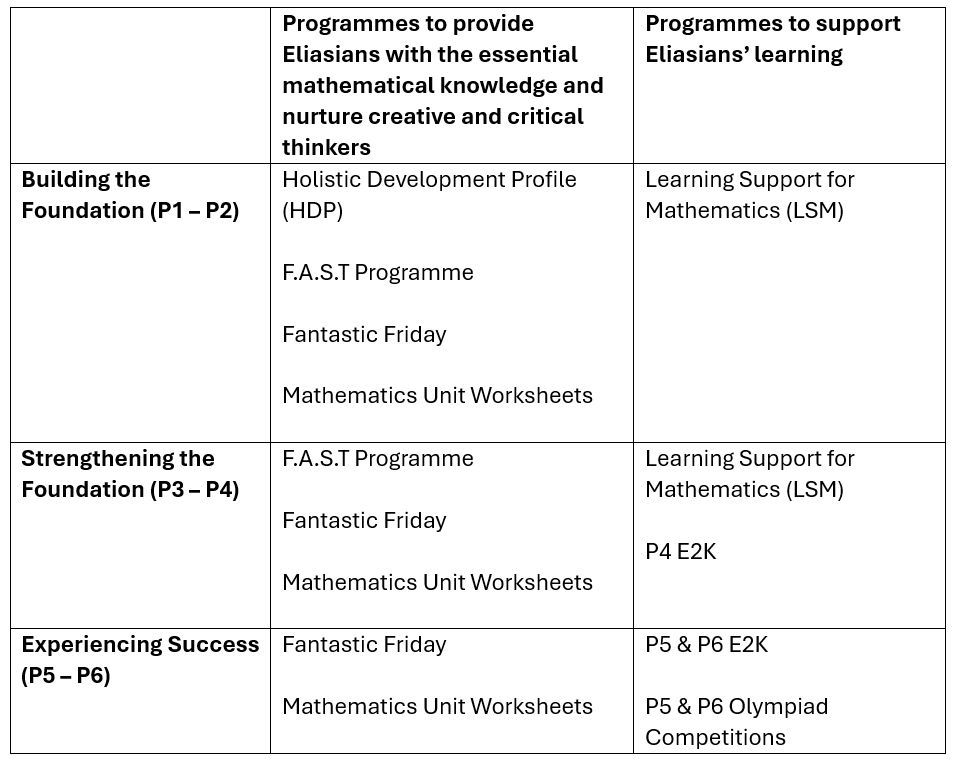
• Learning Support for Mathematics (LSM) Programme for Primary 1 to Primary 4
LSM programme is conducted by trained teachers which aims to provide additional support to students in acquiring basic concepts and skills in mathematics.
• F.A.S.T Progamme (Primary 1 to Primary 4)
F.A.S.T (Fluency, Accuracy, Speed in a given Time) is a programme that aims to improve students’ proficiency in performing calculations involving the 4 operations. The mastery in this area will help students to reduce their cognitive load to allow them to focus on problem-solving matters.
• Mathematical Olympiad Competitions (Primary 5 and 6)
Eliasians who possess great aptitude for Mathematics are identified for this programme. Through the training, they will acquire skills and techniques required to solve challenging problems and be exposed to the spirit of learning through discovery. They will gain a sense of accomplishment through participating in Mathematical Olympiad competitions such as the Asia-Pacific Mathematical Olympiad for Primary Schools (APMOPS) for Primary 6 and National Mathematical Olympiad of Singapore (NMOS) for Primary 5.
• Fantastic Friday
Eliasians will end the week by recalling the concepts taught in the week. This is done via an online Mathematics learning portal which also acts as an additional learning resource for the students. Mathematics teachers will dispatch assignments every Friday based on the integrated approach of interleaved and blocked practice to ensure that their students’ proficiency level in the concepts does not deteriorate over time.
• Mathematics Unit Worksheets (Primary 1 to Primary 6)
A platform for students to communicate and reason processes and conceptual knowledge in written mathematical language. There are also non-routine word problems in the unit worksheets where students work collaboratively to co-construct the strategies with their teachers. This helps to promote metacognition in our students as they reflect on their strategies.
In alignment with our department’s vision and mission, we have put in place a variety of programmes to bring this vision and mission to fruition.